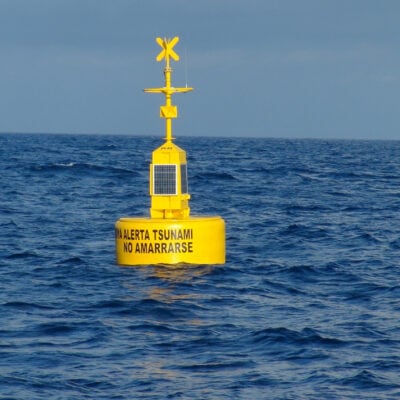
Since 2011, MSM Ocean has implemented several tsunami detection and early warning projects by supplying systems composed of a bottom pressure sensor communicating with a surface buoy linked to a monitoring application at the control centre. These projects have been developed for public authorities in Ecuador, Colombia and Italy, enabling them to obtain real-time information to support decision-making on population warning, as well as historical datasets that contribute to a better understanding of the risks along their coastlines.
The journey began in Ecuador, with a project for the Instituto Oceanográfico y Antártico de la Armada (INOCAR). Since then, MSM Ocean has continued working in this field, with projects involving both the supply of new units and spare units, together with continuous system improvements aimed at ensuring the highest possible data availability, extending service life and reducing maintenance frequency and costs, as well as increasing resistance to vandalism.
A Journey That Began in 2011
The evolution of MSM Ocean’s projects in the field of tsunami detection can be summarised through the following milestones:
- 2011 · Ecuador: project for the Instituto Oceanográfico y Antártico de la Armada (INOCAR), with 1 buoy and 1 spare unit.
- 2014 · Colombia: project for the Colombian Maritime Authority (DIMAR), with 1 buoy and 1 spare unit.
- 2019 · Ecuador: new project for INOCAR, with 2 buoys.
- 2022 · Galápagos Islands, Ecuador: project for INOCAR, with 2 buoys and 2 spare units.
- 2025 · Italy: project for the Istituto Nazionale di Geofisica e Vulcanologia (INGV), with 2 buoys and 2 spare units.

This continuity over more than a decade reflects MSM Ocean’s accumulated experience in the development and supply of solutions for tsunami detection and early warning.
Technology for Tsunami Detection and Early Warning
MSM Ocean’s tsunami buoys are part of a system designed to detect pressure variations compatible with a potential tsunami event and transmit the information to a control centre, where it is processed and the corresponding alert is generated.
The solution combines a surface buoy equipped with a low-power data acquisition unit integrated with an Iridium modem for real-time satellite transmission, and an acoustic transducer for communication with the bottom pressure sensor (BPR, Bottom Pressure Recorder).
The BPR, moored on the seabed and supplied by Sonardyne, MSM Ocean’s technology partner, continuously records pressure variations at the seafloor. The data are transmitted acoustically to the surface buoy and, from there, via satellite link to the control centre. The system processes this information to identify variations compatible with a potential tsunami event and, when the established criteria are met, activate the corresponding alert mechanism.

The system is complemented by monitoring and remote-control software that enables pressure data and generated alerts to be displayed, as well as the status of the equipment to be monitored and the system to be managed remotely.
Experience Applied to New Projects
Tsunami detection and early warning systems require the integration of different technological and operational elements to provide reliable information in demanding marine environments and transmit it rapidly to the centres responsible for emergency management.
The experience accumulated by MSM Ocean since 2011 enables us to approach new projects by considering not only buoy design, but also aspects such as instrumentation, communications, mooring, monitoring and system integration.