On July 29, 2025, a magnitude 8.8 earthquake —the seventh strongest ever recorded in modern history— struck the Kamchatka Peninsula in eastern Russia. The earthquake generated a tsunami that triggered alerts across the Pacific Ocean, from Japan to South America, activating large-scale evacuation and prevention protocols.
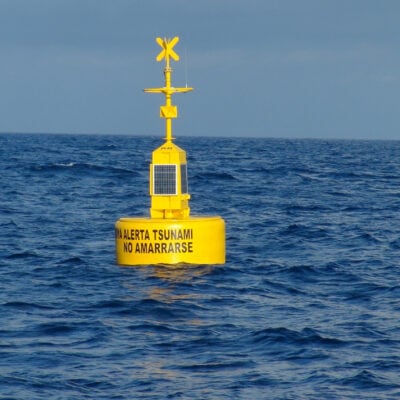
More than 16 hours after the quake, and following a journey of over 11,770 km across the Pacific, the wave generated by this phenomenon was recorded by MSM Ocean’s EBM24-TS tsunami early warning buoy. Installed southeast of the Galápagos Islands and operated by the Ecuadorian Navy’s Oceanographic and Antarctic Institute (INOCAR), this autonomous and self-powered system combines cutting-edge technology with proven long-term reliability.

Real-time detection: a confirmation of reliability
At 15:40 UTC on July 30, the Bottom Pressure Recorder (BPR) integrated into the buoy —deployed at a depth of 3,650 meters— detected the passage of the tsunami. Just 46 seconds later, the signal was received at INOCAR’s Tsunami Warning Center in Ecuador, after being processed and transmitted by the EBM24-TS surface buoy. This real-time information provided authorities with critical data to analyze the wave’s energy, assess risks, and issue appropriate alerts to the population.
This detection confirms the optimal performance of the system, which was fully designed and manufactured by MSM Ocean in collaboration with Sonardyne, a key technology partner and supplier of the BPR system integrated with the buoy. It also highlights the crucial role of INOCAR in the diligent operation and maintenance of the system.

Technology serving prevention
The EBM24-TS buoy that recorded this event is part of the TEWS (Tsunami Early Warning System) developed by MSM Ocean. This state-of-the-art system operates fully autonomously, transmitting real-time data via satellite communications. Its operational reliability had already been demonstrated in recent events, such as:
- The detection of the massive wave generated by the Hunga Tonga submarine volcanic eruption in January 2022.
Read Case Study here. - The recording of the tsunami generated by an earthquake near the Kermadec Islands in 2021.
Read Case Study here.
A key tool to save lives
Technologies like these are essential for protecting coastal communities and enabling rapid decision-making in the face of large-scale natural events. Our team works tirelessly to design, manufacture, and deliver systems with high reliability and operational availability, ensuring effective response given the significant human and material risks these events entail.
At MSM Ocean, we express our solidarity with the affected regions and reaffirm our commitment to developing solutions that help save lives and mitigate risks.